
Every retailer orders differently. Your brand only sees one format.
Retailers send what they send. Brydge reads it, checks every line against your catalogue, and puts one clean order into your ERP.
Every way in. One way into your ERP.
Six retailers, six ways of asking for the same thing. Your team sees one standardised order.

validated,
matched.
What slows a brand down.
Three problems, and what replaces each one.
Your team rekeys the same season six ways, and the mistakes land in your ERP rather than in the file.
Brydge reads whatever arrives — a spreadsheet, a PDF, a photograph of an order sheet — and works out the structure itself.
Volume doubles at market and the only lever anybody has is another pair of hands on the order desk.
The same team covers a peak week, because the reading and the checking are no longer theirs to do.
A wrong SKU or a missed delivery date becomes a chargeback, and then a conversation about trust.
Every line is matched to your real SKUs and variants, and anything uncertain is held for a person instead of guessed.
Every order, and what happened to it.
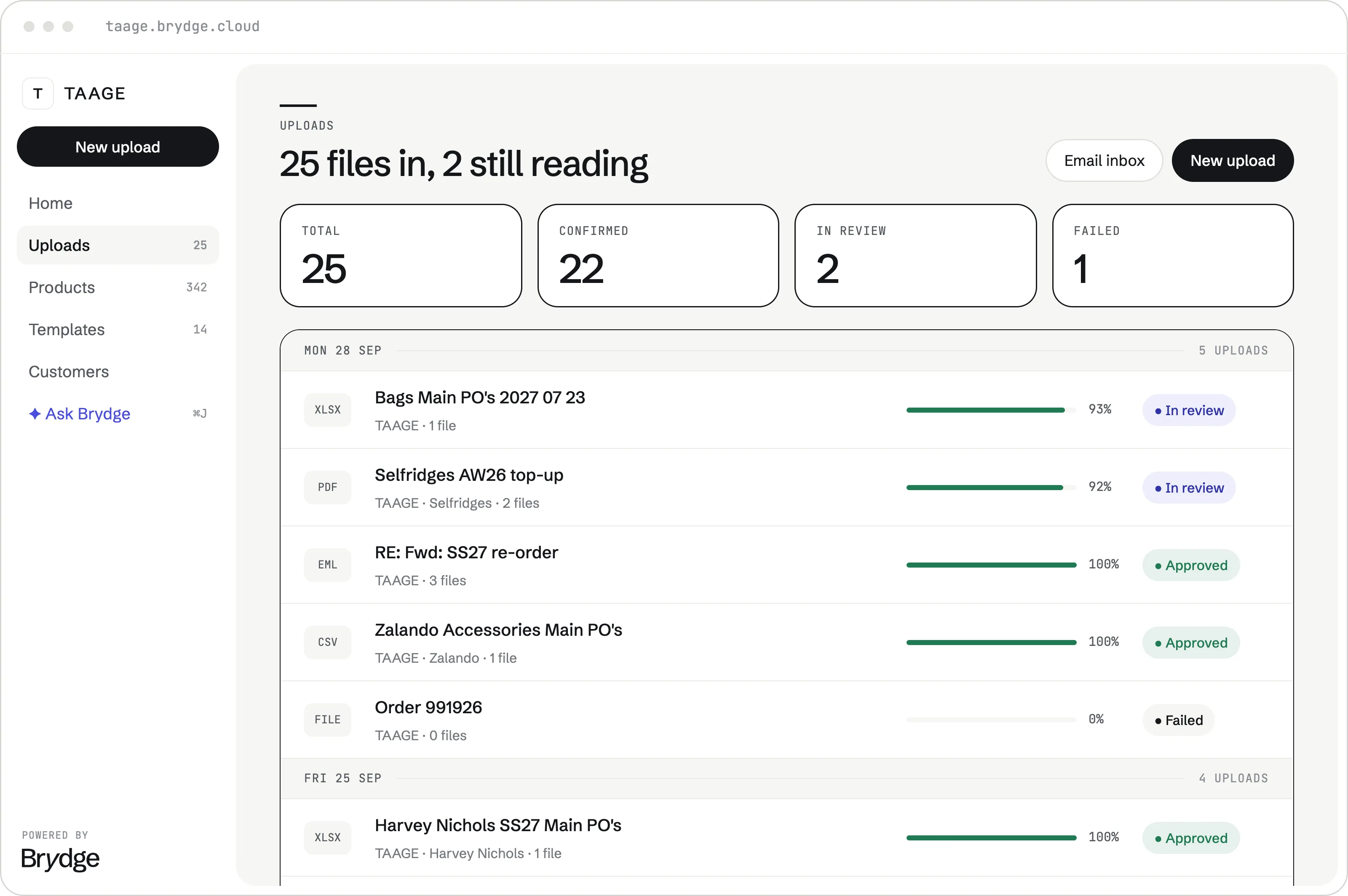
The workspace your team signs into. What arrived, what Brydge read, what it matched, and the one line it wants you to look at.
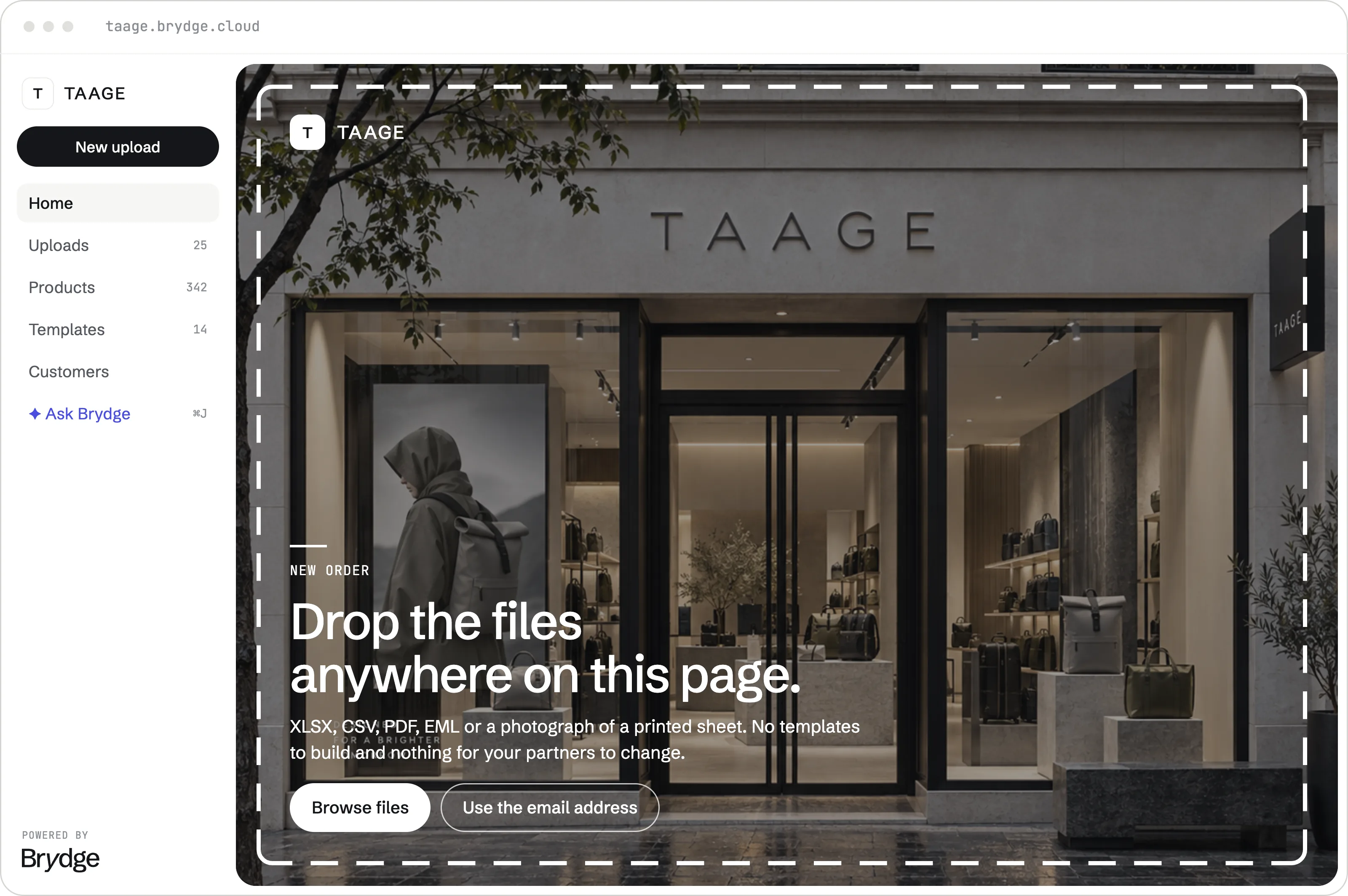
Drag a file in, or paste a screenshot of one — up to 100MB each. For most people that is the whole of the job.
Whatever your customer sent is what you upload. Brydge works out the structure on the way in.
Your logo and campaign imagery, on your own subdomain. Agencies switch between client brands from the rail.
Every file keeps its history. Open last Tuesday's order and see what Brydge read, what it matched and what it changed.
Totals across the top and a filter for the ones still in review — so you look at the exceptions, not all twenty-two.
Give a customer a dedicated inbox and what they send arrives in the same list as everything else.
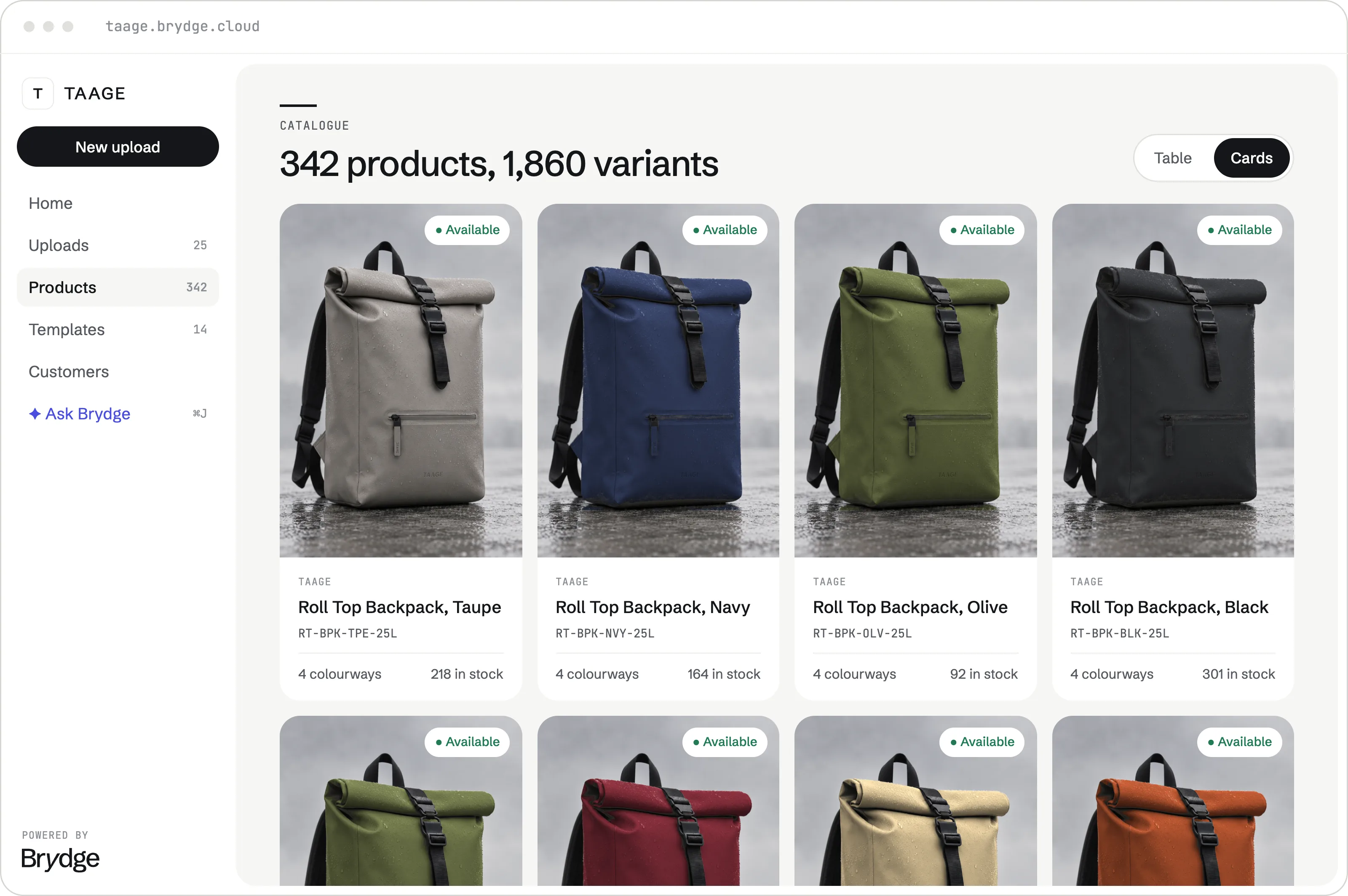
Import it once and every order is matched against your real SKUs, variants and attributes.
By title, SKU, ID, colour, size, or any attribute you have set up — not only an exact code.
Size runs, colourways and availability, so every match is checked against what actually exists.
It learns each retailer's order files.
Show Brydge one order file from a retailer and it learns how their files are built. Everything they send after that lands cleaner.
It works out the structure from a single file.
Write down anything odd about a customer. Once.
Split by PO, split by store, spread across size runs.
Format changed? Update it and run it again.
What you get
A single platform for every retailer order, in every format.
However an order arrives, it lands in one place for your team to review and approve.
Mismatches, missing fields and exceptions are flagged before anything reaches your ERP.
Push approved orders straight into your OMS or ERP. No re-keying, no export and import dance.
The source file, the validations and the export status, kept against every order.
Bring us your worst retailer file.
The one nobody wants to open. We will run it live on the call — your catalogue, your format, your ERP.